GLP-1 COMPARISON
Semaglutide vs Tirzepatide (2026):
Which Produces More Weight Loss?
The first head-to-head clinical trial has settled the debate. Tirzepatide produces significantly more weight loss than semaglutide. But the right medication for you depends on more than just the trial data. Here is everything you need to know.
By The Dose Report Editorial Team | Updated May 2026 | 12 min read
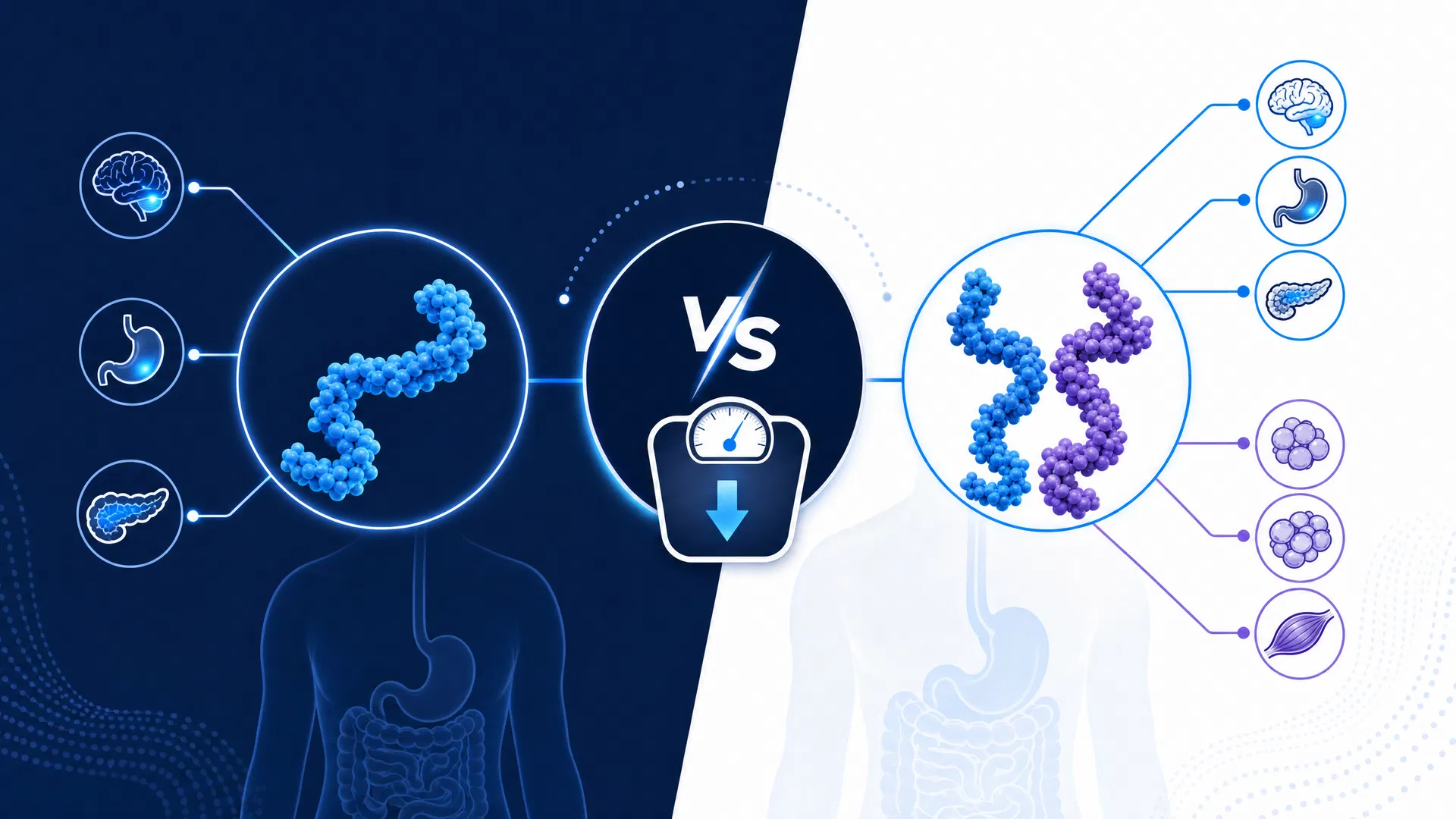
If you have been researching GLP-1 medications, you have almost certainly asked this question: should I take semaglutide (the active ingredient in Ozempic and Wegovy) or tirzepatide (the active ingredient in Mounjaro and Zepbound)? For years, the answer required comparing results from separate clinical trials. In 2025, the SURMOUNT-5 trial provided the first direct head-to-head answer. The result was unambiguous: tirzepatide produces significantly more weight loss. But the full picture is more nuanced than a single headline. If you want a personalised recommendation based on your specific situation, take our free 2-minute quiz here.
Find Your Best Match
Not Sure Which Medication Is Right for You?
Take our free 2-minute quiz. We’ll match you with the GLP-1 telehealth program that fits your state, budget, and goals. You can also use free GLP-1 quiz to get a personalised recommendation based on your state and budget.
The One-Minute Summary
Semaglutide (Ozempic / Wegovy)
~14% average weight loss
GLP-1 receptor agonist. FDA-approved for weight loss (Wegovy) and diabetes (Ozempic). Extensively studied with 5+ years of real-world data. Widely available through telehealth.
Choose Semaglutide If
You want the most studied option with the longest real-world safety record, or if tirzepatide is not available in your area
Tirzepatide (Mounjaro / Zepbound)
~20% average weight loss
GLP-1 + GIP dual agonist. FDA-approved for weight loss (Zepbound) and diabetes (Mounjaro). Produces significantly more weight loss in head-to-head trials. Newer, less long-term data.
Choose Tirzepatide If
You want maximum weight loss and are comfortable with a newer medication that has slightly less long-term safety data
The Head-to-Head Data
SURMOUNT-5 data from Aronne et al., NEJM 2025. Real-world data from Drugs.com comparative analysis. Brand-name prices approximate and subject to change.
How They Work Differently
Understanding why tirzepatide produces more weight loss requires understanding the biological difference between the two medications.
Semaglutide: GLP-1 Receptor Agonist
Semaglutide mimics glucagon-like peptide-1 (GLP-1), a hormone your gut naturally produces after eating. GLP-1 signals the brain to reduce appetite, slows the rate at which the stomach empties, and helps regulate blood sugar by stimulating insulin release. Semaglutide activates only the GLP-1 receptor.
Tirzepatide: GLP-1 + GIP Dual Agonist
Tirzepatide activates two receptors simultaneously: GLP-1 and GIP (glucose-dependent insulinotropic polypeptide). GIP is another gut hormone involved in metabolic regulation. The dual-hormone mechanism appears to enhance appetite suppression and fat metabolism more comprehensively than GLP-1 activation alone. This is the biological reason tirzepatide consistently outperforms semaglutide in weight loss trials — it is hitting two targets instead of one.
The SURMOUNT-5 trial, published in the New England Journal of Medicine in May 2025, was the first randomised head-to-head comparison of the two medications in patients with obesity but without diabetes. At 72 weeks, tirzepatide produced an average weight loss of 20.2% compared to 13.7% for semaglutide — a statistically significant difference across all key endpoints.
Side Effects: More Similar Than Different
Both medications share the same class of side effects because they both activate the GLP-1 receptor. The most common are gastrointestinal: nausea, vomiting, diarrhea, and constipation. These are worst during the titration phase and typically improve as the body adjusts.
There are some nuanced differences. Some studies suggest tirzepatide may cause slightly more nausea at equivalent doses, though this is not consistent across all trials. Both carry the same black box warning about a potential risk of medullary thyroid carcinoma based on animal studies. Both are contraindicated in patients with a personal or family history of medullary thyroid cancer or MEN2.
The Muscle Loss Question
Both medications carry the same risk of lean muscle mass loss during weight loss — approximately 25–40% of the weight lost can come from lean tissue rather than fat. Because tirzepatide produces more total weight loss, the absolute amount of muscle lost may be higher. This makes adequate protein intake (at least 1.2–1.6g per kg of body weight daily) and regular resistance training even more important on tirzepatide than on semaglutide.
Cost: Compounded vs. Brand-Name
Brand-name Wegovy (semaglutide) costs approximately $1,300/month without insurance. Brand-name Zepbound (tirzepatide) costs approximately $1,060/month. Both are expensive, and insurance coverage for weight loss remains limited.
The more relevant comparison for most patients is the compounded medication market, where telehealth platforms offer both medications at a fraction of the brand-name cost. Mochi Health offers compounded semaglutide at $99/month and compounded tirzepatide at $199/month — flat rate at all doses. Yucca Health offers both starting from $146/month (semaglutide) and $258/month (tirzepatide) on a 6-month plan.
The Cost-Effectiveness Question
Tirzepatide typically costs $50–$100/month more than semaglutide through compounded telehealth platforms. Given that it produces approximately 50% more weight loss on average, the cost-per-pound-lost calculation often favours tirzepatide despite the higher monthly price. However, this calculation only holds if you respond well to tirzepatide — individual response varies significantly.
Which Should You Choose?
Choose Tirzepatide If:
- Maximum weight loss is your primary goal and you want the most effective option currently available
- You have tried semaglutide before and did not achieve the results you wanted
- You are comfortable with a medication that has slightly less long-term safety data (3 years vs. 5+ years for semaglutide)
- Your budget allows for the slightly higher monthly cost
Choose Semaglutide If:
- You want the most extensively studied GLP-1 medication with the longest real-world safety record
- You have established cardiovascular disease — semaglutide has the strongest cardiovascular outcomes data (SELECT trial: 20% reduction in MACE)
- You are more cost-sensitive and want the lower-priced option
- Tirzepatide is not available through your preferred telehealth platform or in your state
It is also worth noting that individual response varies considerably. Some patients respond better to semaglutide than tirzepatide and vice versa. If you try one and do not achieve adequate appetite suppression or weight loss at the maximum tolerated dose, switching to the other is a clinically reasonable next step.
Platforms like SkinnyRx and Willow offer both medications, making it straightforward to switch if needed. Maximus also offers both alongside testosterone optimization for men.
Frequently Asked Questions
Is tirzepatide always better than semaglutide?
On average, yes — the SURMOUNT-5 trial showed tirzepatide produces significantly more weight loss. However, individual response varies. Some patients achieve excellent results on semaglutide and do not need to switch. The best medication is the one that produces adequate appetite suppression for you at a tolerable dose.
Can I switch from semaglutide to tirzepatide?
Yes. If you have been on semaglutide and are not achieving your goals, switching to tirzepatide is a clinically reasonable option. Your provider will typically start you at a low tirzepatide dose and titrate up, regardless of what dose of semaglutide you were on.
Is compounded tirzepatide the same as Zepbound?
Compounded tirzepatide contains the same active ingredient as Zepbound, but it is not an FDA-approved finished product. It is prepared by licensed compounding pharmacies and has not undergone the same FDA review process for safety, efficacy, and quality consistency as brand-name Zepbound.
Which is safer — semaglutide or tirzepatide?
Both have similar safety profiles. Semaglutide has a longer real-world safety record (5+ years vs. ~3 years for tirzepatide). Both carry the same black box warning about thyroid C-cell tumors based on animal studies. Neither has shown a significant safety signal in clinical trials that would favour one over the other for most patients.
Ready to Get Started?
Find the Right Program for Your Goals
Take our free 2-minute quiz and we’ll match you with the GLP-1 telehealth program that fits your state, budget, and whether you want semaglutide or tirzepatide.
Affiliate Disclosure: Some links on this page may earn us a commission at no extra cost to you. This does not affect our editorial opinion.

Your independent source for GLP-1 and weight loss product reviews, news, and expert tips.
QUICK LINKS
Affiliate Disclosure: TheDoseReport.com participates in affiliate programs. Some links on this site may earn us a commission at no extra cost to you. This does not influence our editorial content. All reviews and opinions are our own.
Medical Disclaimer: This website does not provide medical advice. All content is for informational purposes only. Always consult a qualified healthcare professional before starting any weight loss program or medication.